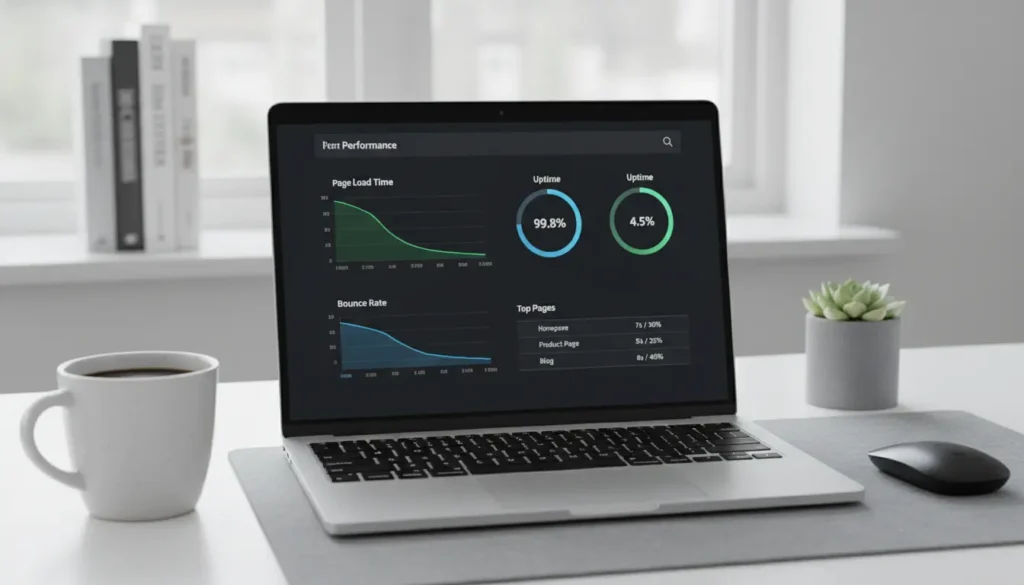
Why website loading speed matters
Website loading speed affects user experience, conversions, and search rankings. Faster pages keep visitors engaged and reduce bounce rates.
Search engines use page speed as a ranking factor, so improving load time is an SEO win as well as a usability improvement.
Key factors that affect website loading speed

Understanding the main causes helps you target fixes efficiently. Common factors include hosting, images, code, and external scripts.
Hosting and server configuration for website loading speed
Cheap shared hosting can slow response times. Choose hosting that matches your traffic and technology stack.
Consider server-side improvements: PHP versions, HTTP/2 or HTTP/3 support, and optimized database settings.
Images and media impact on website loading speed

Large images are the most frequent cause of slow pages. Compress, resize, and serve them in modern formats like WebP when possible.
Use lazy loading for images below the fold so they don’t block initial rendering.
Code, CSS, and JavaScript affecting website loading speed
Unminified CSS and JS increase payload size. Remove unused code and defer noncritical scripts to avoid render-blocking.

Bundle files sensibly to reduce HTTP requests, but avoid excessive bundling that delays critical rendering.
Caching, CDNs, and website loading speed
Browser caching reduces repeat load times. Set appropriate cache headers for static assets.
A Content Delivery Network (CDN) serves files from locations closer to visitors, cutting latency for global audiences.
Third-party scripts and integrations
Analytics, chat widgets, and ad networks can add latency. Audit third-party scripts and load them asynchronously if possible.
Limit or replace heavy widgets with lightweight alternatives when they harm performance.
Step-by-step checklist to improve website loading speed
Follow these steps in order to get measurable results quickly. Test after each change to measure impact.
- Measure baseline performance using PageSpeed Insights, WebPageTest, or Lighthouse.
- Upgrade hosting or enable HTTP/2 if server response is slow.
- Optimize and compress images; implement lazy loading.
- Minify CSS and JavaScript; defer noncritical JS.
- Enable Gzip or Brotli compression for text assets.
- Set long cache lifetimes for static assets and use cache busting for updates.
- Use a CDN for global traffic or large static files.
- Audit and remove unnecessary third-party scripts.
- Implement critical CSS and preload key resources for faster first paint.
- Repeat testing and monitor Core Web Vitals in Search Console.
Practical tips and configurations for faster pages
Small configuration changes often produce large gains. Focus on low-effort, high-impact wins first.
- Serve images scaled to display size to avoid client-side resizing.
- Use resource hints like preload for fonts and hero images.
- Enable HTTP caching and use cache-control headers strategically.
- Avoid large layout shifts by setting image dimensions and reserving space for embeds.
Did You Know?
Real-world example: small e-commerce case study
Case: A regional online store averaged 3.9 seconds to interactive and a 2.4% conversion rate. They followed the checklist above over three weeks.
Actions taken: moved to a VPS with HTTP/2, optimized product images (50% smaller), enabled Brotli compression, and deferred nonessential scripts.
Results: Time to interactive dropped to 1.6 seconds and conversion rate rose to 3.1%, a relative increase of about 29% in conversions.
How to measure ongoing website loading speed
Use both lab and field tools: Lighthouse and WebPageTest for controlled testing, and Chrome UX Report or RUM tools for real-user metrics.
Track Core Web Vitals: Largest Contentful Paint (LCP), First Input Delay (FID) or Interaction to Next Paint (INP), and Cumulative Layout Shift (CLS).
Common pitfalls and how to avoid them
Don’t optimize blindly. Changes can break functionality or create caching issues. Always test on a staging site first.
Avoid over-optimizing images to the point of visible quality loss. Maintain a balance between file size and visual fidelity.
Final checklist before launch
- Run a final Lighthouse audit and compare to baseline scores.
- Verify caching headers and CDN configuration in production.
- Monitor real-user metrics for 2–4 weeks to catch regressions.
- Document changes and rollback plans for future updates.
Improving website loading speed is an iterative process. Apply high-impact fixes first, measure frequently, and keep performance part of your deployment workflow.



