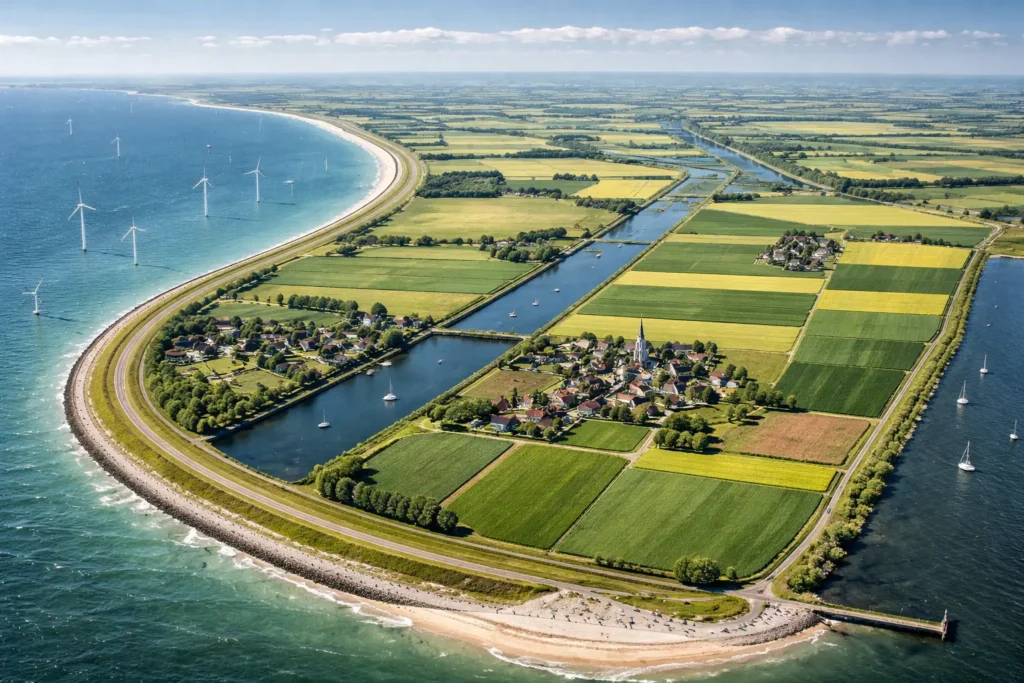
Overview: diverting rivers to reshape the coastline
The Netherlands has a long history of using engineering to live with water. In recent decades the country expanded this work by redirecting flows and managing sediment to reshape its coastline and reclaim land.
This article explains the main techniques, the planning steps, and practical trade-offs you should consider if you study or replicate similar projects.
Why divert rivers and reclaim land in the Netherlands

Land is scarce and coastal protection is essential in a low-lying country. Reclaiming land supports ports, industry, housing, and nature projects.
Diverting rivers changes where sediment is deposited. Controlled diversion can move silt and sand to target areas, accelerating natural land-building processes.
Primary goals of river diversion projects
- Create safe, elevated land for infrastructure and development.
- Strengthen or reshape the coastline to reduce erosion and flood risk.
- Restore or create wetlands and ecological habitats using sediment.
Techniques used when diverting rivers and reclaiming land
Engineers combine hard and soft measures. The main techniques are temporary channel diversion, sediment bypassing, dredging and placement, and coastal nourishment.

Each technique has implementation details and monitoring needs that affect cost and environmental outcomes.
Temporary channel diversion
Building a temporary channel or weir can reroute flow away from a construction area. This allows controlled deposition of sediment in a chosen location.
Temporary diversion can last years while sediments accumulate, and it often requires staged removal and stabilization work afterward.
Sediment bypassing and dredging

In many projects, dredgers capture sediment from river mouths or channels and pump it to desired locations. Bypassing systems can move material continuously to mimic natural transport.
This reduces the need for large permanent structures and can be more flexible than full river diversion.
Coastal nourishment and the Sand Motor approach
The Sand Motor is an example of depositing a large volume of sand in one place to let currents distribute it over years. Similar logic applies when diverting rivers to deliver silt to nearby shallow areas.
These approaches favor long-term, low-maintenance coastal shaping rather than building fixed seawalls alone.
Planning and regulatory steps to divert rivers
Projects must balance engineering goals with environmental law, water management plans, and stakeholder interests. Early studies should include hydrodynamic modeling and ecological impact assessments.
Common planning steps include permitting, staged construction, adaptive monitoring, and contingency measures for unexpected flood conditions.
Key monitoring metrics
- Flow velocities and flood levels
- Rates of sediment deposition and erosion
- Water quality indicators (turbidity, oxygen)
- Habitat response for birds, fish, and vegetation
Environmental and social trade-offs
Diverting rivers affects downstream users, fisheries, and wetlands. Sediment that benefits one site may deprive another.
Mitigation often includes habitat offsets, seasonal timing restrictions, and coordinated water management with neighboring regions.
Case study: Marker Wadden — using sediment to build islands
The Marker Wadden project in the Markermeer is a practical example of directing sediment to create new land and habitats. Engineers used dredged sediment and carefully managed water flows to build a chain of islands for birds and wetlands.
The project began with targeted dredging and placement, followed by ongoing monitoring. It shows how sediment can be relocated in a controlled way to achieve ecological and coastal goals.
Small real-world example: Maasvlakte and port expansion
Maasvlakte 2 expanded the Port of Rotterdam by reclaiming dry land from the North Sea using millions of cubic meters of sand. Though not a river diversion per se, the work demonstrates large-scale sediment placement and coastal reshaping techniques used in the Netherlands.
Lessons include careful sequencing, robust monitoring, and long-term shoreline management plans to address evolving currents and sediment patterns.
Step-by-step practical guide if you want to study or plan a river diversion
- Define clear objectives: flood safety, land creation, or habitat restoration.
- Conduct hydrodynamic and sediment transport modeling.
- Engage stakeholders early: ports, farmers, nature organizations, residents.
- Design temporary and permanent works with adaptivity in mind.
- Secure permits and set monitoring and trigger thresholds.
- Implement in stages and review data to adjust operations.
Examples of measurable outcomes to track
- Area of new dry land or wetland created (hectares)
- Change in flood risk metrics (return period) for nearby communities
- Species recolonization rates in newly created habitats
- Net sediment budget for the local coastal cell
Conclusions: practical takeaways
Diverting rivers and managing sediment have allowed the Netherlands to reshape its coastline and reclaim useful land while balancing flood safety and ecology.
Successful projects combine robust modeling, staged construction, active monitoring, and stakeholder coordination. The Netherlands offers many practical lessons for similar efforts worldwide.
If you plan or evaluate a river diversion, focus on clear objectives, adaptive design, and measurable environmental safeguards to limit unintended impacts.



