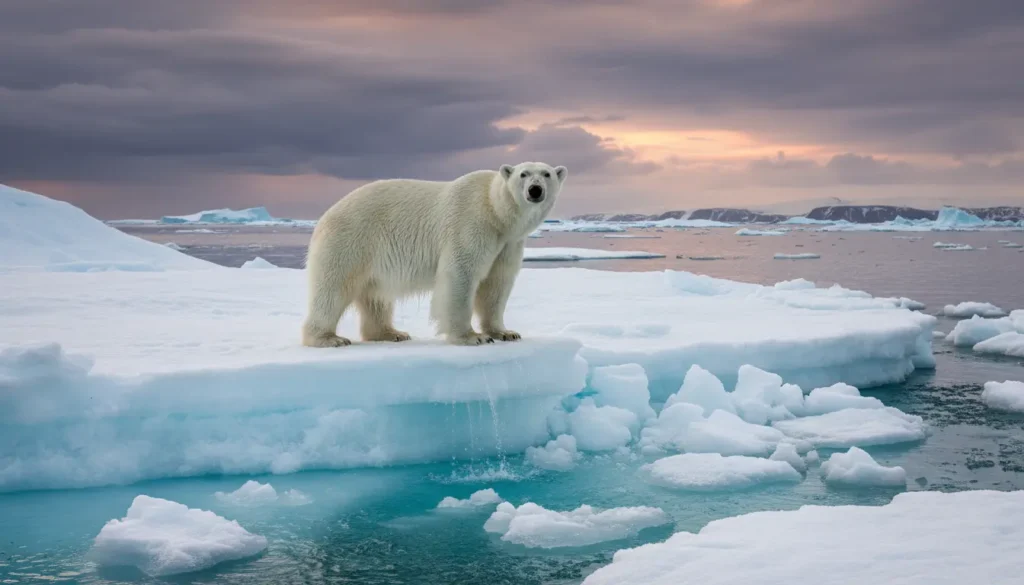
Why a Massive Ice Crack Matters for Polar Bears
Polar bears depend on stable sea ice as a platform for hunting seals, traveling, and breeding. A sudden, large ice crack or rift can shrink their hunting grounds and force longer swims between floes.
These changes lower body condition, reduce cub survival, and push bears closer to human communities. Understanding the mechanics of a massive ice crack helps communities and policymakers prioritize responses.
How a Massive Ice Crack Can Threaten Global Systems

Beyond wildlife impacts, an extensive rift or accelerated ice break-up can affect sea level, ocean circulation, and carbon feedbacks. Large-scale ice loss alters how the ocean and atmosphere exchange heat and gases.
These changes can cascade — shifting currents, increasing storm intensity, and releasing trapped greenhouse gases. The risk is not just local; it has regional and global consequences.
Sea Level Rise and Ocean Currents
When land ice (glaciers and ice sheets) calves or melts rapidly, added water contributes to sea level rise. While sea ice melt itself does not raise sea level, its loss changes albedo and ocean surface dynamics.

Reduced sea ice can warm surface waters, altering the strength and paths of currents such as the Atlantic Meridional Overturning Circulation (AMOC). Small changes in these systems can influence weather far from the Arctic.
Methane Release and Climate Feedbacks
Thawing permafrost and destabilized subsea methane hydrates are potential feedbacks linked to rapid ice changes. If warming and ice loss accelerate, these feedbacks could amplify global warming.
That amplifying effect increases the long-term hazard exposure for coastal communities and ecosystems worldwide.
How Scientists Monitor Massive Ice Cracks

Monitoring relies on satellites, aerial surveys, ocean buoys, and on-the-ground observations. Remote sensing detects rifts early and tracks propagation across seasons.
Data is shared through international networks to update forecasts and hazard assessments. This multi-source approach improves accuracy and response time.
Key Monitoring Tools
- Satellite radar and optical imagery for real-time rift detection.
- Ice-penetrating radar to measure ice thickness and stability.
- Oceanographic buoys to record temperature, salinity, and currents.
- Local field teams to validate remote observations and study wildlife impacts.
Practical Steps to Respond to a Massive Ice Crack
Communities, conservation groups, and governments can take practical steps to reduce risk and adapt. The goal is to protect both people and key ecosystems such as polar bear habitat.
Actions range from immediate monitoring to longer-term policy and conservation measures.
Immediate Actions
- Increase satellite and aerial surveillance of the affected region to track rift growth.
- Deploy ocean buoys and autonomous sensors to detect changes in currents and temperature.
- Alert local communities and shipping operators about sea ice hazards.
Medium- and Long-Term Measures
- Strengthen protected areas for polar bears and critical hunting grounds.
- Fund interdisciplinary research into feedbacks between ice loss and global climate systems.
- Include Arctic ice stability in national climate adaptation and coastal planning.
Case Study: Petermann Glacier Calvings and Lessons Learned
Past calving events at Greenland’s Petermann Glacier provide a useful example. In the early 2010s, large rifts formed and produced massive ice islands that changed regional sea ice patterns.
Researchers used satellite imagery to track the rifts and modeled ocean responses. Lessons included the value of continuous monitoring and rapid data-sharing between nations.
That case showed how a single large event can alter local biodiversity and navigation routes while providing early-warning best practices for future events.
Polar bears use sea ice as a hunting platform and can fast for months when ice is scarce. Declines in seasonal sea ice are directly linked to lower reproduction and higher mortality in many populations.
What Communities and Policymakers Can Do Now
Policy and community planning should prioritize both mitigation and adaptation. Reducing greenhouse gas emissions lowers the probability of extreme ice events long term.
At the same time, investment in monitoring infrastructure, wildlife protection, and coastal resilience addresses near-term risks.
Action Checklist for Officials and Planners
- Integrate Arctic ice-monitoring data into emergency planning and maritime advisories.
- Support indigenous and local monitoring networks to combine scientific and traditional knowledge.
- Allocate funding for contingency plans for wildlife rescue and oil spill response in changing ice conditions.
- Promote international collaboration on Arctic research and climate policy.
Simple Steps Individuals Can Take
Individuals can support science and policy through informed choices. Reducing personal emissions and supporting reputable conservation organizations helps the larger effort.
Staying informed and sharing accurate information supports community resilience and public pressure for policy action.
Final Takeaway
A massive ice crack in the Arctic is more than a regional wildlife issue. It is a signal of systemic change that carries local and global consequences.
Practical steps—improved monitoring, policy integration, and community preparedness—can reduce immediate harm and inform better long-term climate decisions.



