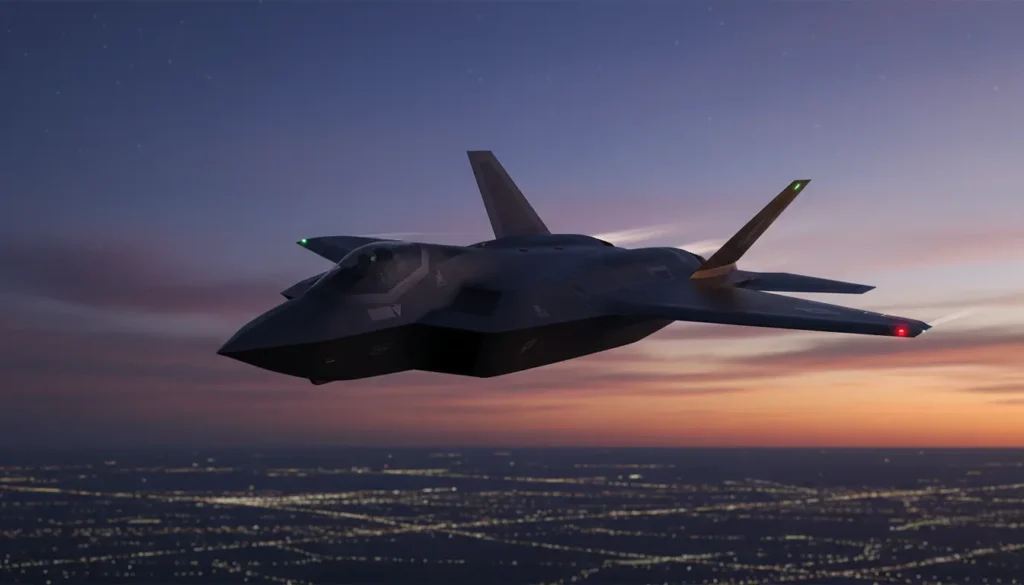
New research into quantum sensing and quantum radar has generated headlines suggesting stealth fighters might become detectable by a new class of sensors. This article gives a practical, neutral guide to what quantum radar is, how it could affect stealth aircraft, and the real technical and operational limits to those claims.
What is quantum radar and why it matters
Quantum radar is a proposed sensing approach that uses quantum properties such as entanglement and squeezed light to improve detection of objects in cluttered environments. The idea is to leverage correlations between photons to improve signal-versus-noise performance compared with classical radar.

Interest stems from the potential to detect low-observable targets, reduce false alarms, or operate with lower transmit power. However, lab promise does not equal immediate battlefield capability.
How quantum radar would work in simple terms
At a basic level, quantum radar concepts follow a few common steps. First, a source generates correlated or entangled photon pairs. One photon (the signal) is sent toward the target, while the partner photon (the idler) is retained for joint measurement.
When the reflected signal returns, the system compares it against the idler to improve discrimination of target echoes from thermal noise or jamming. In ideal conditions, these correlations can boost detection sensitivity.
Key components of a quantum radar system
- Entangled or correlated photon source
- Low-noise receivers for weak optical or microwave returns
- Time-synchronized joint detection electronics
- Signal processing that exploits quantum correlations
Can quantum radar detect stealth fighters?

Short answer: not reliably at operational ranges today. Stealth fighters are designed to reduce radar cross section across radar bands and viewing angles. Quantum radar research aims to improve detection under certain conditions, but many practical barriers remain.
Experts emphasize that laboratory demonstrations often use short ranges, controlled backgrounds, and idealized targets. Extending those results to long-range air-defense scenarios is nontrivial.
Major technical challenges for quantum radar
- Decoherence and loss: Entanglement degrades rapidly in real-world air and clutter, limiting range.
- Signal strength and range: Quantum schemes often rely on very weak signals, making long-range detection difficult.
- Environmental noise: Weather, foliage, and urban clutter reduce quantum advantage.
- Bandwidth and resolution: Matching operational radar bandwidths and resolutions is technically demanding.
- Countermeasures: Adversaries can alter reflectivity or use decoys and jamming against new sensor types.
Realistic timeline and development path
Quantum sensing will likely follow the usual research-to-field path: theory, lab experiments, prototypes, and then limited trials. Expect initial benefits in niche roles rather than wholesale obsolescence of stealth.

Near-term applications are more plausible in short-range, high-resolution tasks: port security, through-wall sensing, or specialized ground and maritime surveillance where distances are modest and environments are controllable.
Quantum radar research focuses on using correlations between photons to reduce false alarms, not magic detection that ignores physics. Improvements are incremental and highly dependent on range and environment.
Case study: Public claims and measured reality
In 2016 a public claim emerged that a quantum radar prototype had detected stealth aircraft. This generated significant media attention and concern among planners. Analysts reviewed the claim and noted the demonstration, if real, occurred in a limited environment at short range and did not account for operational countermeasures.
That case shows a common pattern: initial demonstrations highlight potential advantages, but follow-up research and independent testing are essential before changing doctrine or procurement based on early results.
Practical guidance for defense planners and engineers
Decision makers should balance optimism with engineering realism. Quantum radar could complement, not replace, existing sensors for many years.
Recommended actions include:
- Monitor validated experiments and peer-reviewed results rather than headlines.
- Invest in testbeds that measure range, resolution, and environmental sensitivity under realistic conditions.
- Assess integration paths: can quantum sensors feed existing C4ISR systems and fusion algorithms?
- Evaluate counter-countermeasure research and adversary responses.
What manufacturers can prioritize
- Robust sources that tolerate loss and noise
- Practical receiver hardware compatible with existing radar bands
- Signal processing that fuses quantum sensor outputs with classical radar data
- Field trials across seasons, terrains, and weather
Conclusions: A quantum leap or gradual evolution?
Quantum radar represents an exciting scientific direction with potential to enhance certain sensing tasks. However, current evidence supports a cautious view: incremental improvements are likely before any disruptive change to stealth effectiveness.
For planners and engineers, the sensible path is sustained research, rigorous testing, and pragmatic integration planning rather than assuming immediate invisibility of stealth fighters has ended.
Short example: A coastal surveillance team could deploy a short-range quantum-enhanced sensor to better spot small, low-signature boats at night. In that controlled environment, quantum correlations may reduce false alarms and aid operator decisions. But the same sensor would not instantly detect a stealth aircraft at hundreds of kilometers.



