What the Snow Moon peaks means for UK viewers
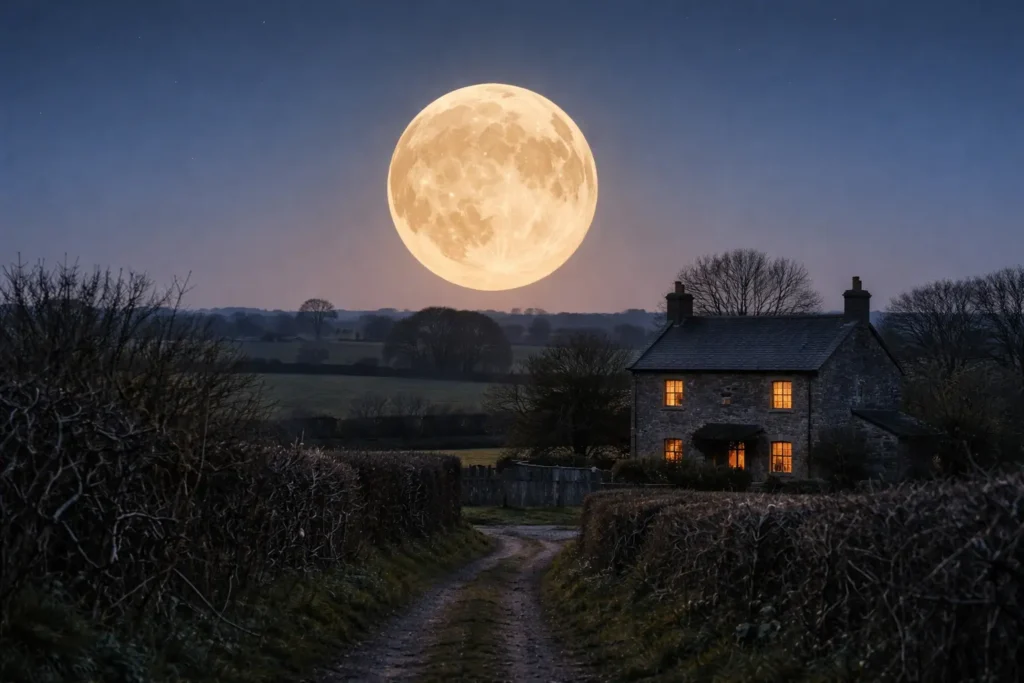
The Snow Moon is a traditional name for the full moon that occurs in February. When news says the Snow Moon peaks, it means the moon reaches full phase and its illumination is at or very near 100 percent.
Peak time is when the moon looks fullest and brightest, but you can usually see it for a day or two either side of the exact moment. That means if you missed the precise peak, there’s still time to view it tonight.
When to look: timing and visibility

Full moon timing is given in Coordinated Universal Time (UTC) or British time (GMT or BST). Check a reliable local source for the exact peak time for your area.
The moon rises roughly at the time of sunset during the day of full moon, and stays visible all night. Look toward the east after sunset to catch the rising Snow Moon, or to the south as the night progresses.
How weather affects seeing the Snow Moon peaks
Clear skies give the best view, but the moon is bright and can be seen through thin cloud layers. Heavy cloud or rain will block the view entirely.
- Check the UK Met Office or a local weather app for cloud cover forecasts.
- Look for breaks in cloud near the moon’s direction; a short clear window may be enough.
- Higher ground often reduces low-level fog or mist that can dim the view.
Where to look in the UK

Urban light pollution makes the moon easy to find, since it is bright, but it can reduce contrast if you want to see lunar surface detail. For clearer views try parks, coastlines or rural areas.
Good spots include open horizons like beaches or hills, and any place with an unobstructed view to the east and south. If you are in a built-up area, find a higher vantage point such as a hill or rooftop with safe access.
Practical viewing checklist
- Check peak time for the Snow Moon and local sunset/sunrise times.
- Look up the weather and cloud cover for the evening.
- Choose a safe, open spot with an unobstructed horizon.
- Bring warm clothing, a torch, and a thermos if you plan to stay outside.
- If photographing, bring a tripod and a suitable camera or smartphone mount.
Simple equipment that helps
You do not need a telescope to enjoy the Snow Moon. The naked eye shows the full disc and colour well. Binoculars reveal craters and maria as bright and dark patches.

For photography, a tripod is the single most useful item. A long lens or a smartphone with a clipped telephoto will capture the moon’s disk more clearly.
Camera settings and tips
- Use manual exposure if possible. The moon is bright: try ISO 100–400, aperture f/8–f/11, and shutter speed 1/125–1/500s as starting points.
- Avoid zooming digitally on a phone. Use a tripod and the phone’s optical zoom or a telephoto lens if available.
- Use a timer or remote shutter to prevent camera shake. Bracketing multiple exposures helps with focus and clarity.
The name Snow Moon comes from Native American and early colonial English traditions. It often marks a time of heavy winter weather in the Northern Hemisphere.
Why the Snow Moon can look different
The Snow Moon may appear larger near the horizon due to a visual effect called the moon illusion. Atmospheric haze can tint it orange or red during rise or set.
Occasionally the moon appears slightly dimmer when it is near apogee (its farthest point from Earth) and brighter near perigee (its closest point). These differences are subtle and may not be noticeable without direct comparison.
Short case study: Evening observation in Manchester
On the night the Snow Moon peaked this year, a small group of amateur astronomers met at a park on the outskirts of Manchester. Cloud cover was patchy, and they waited until a short clear gap at 21:40 GMT.
Using binoculars and a 6-inch Dobsonian telescope, they observed prominent craters and the Sea of Tranquillity. Several members photographed the moon with phones attached to the eyepiece, sharing tips on exposure and steadying the camera.
The group demonstrates how flexible planning, simple equipment and patience can produce satisfying views even when conditions are not perfect.
Safety and courtesy tips for night viewing
Always choose legal, safe viewing locations and respect private property. Stay off roadways and be mindful of other park users.
Use a red filter or low-brightness mode on torches to preserve night vision. If in a group, keep noise and lights down to avoid disturbing wildlife or neighbours.
Final checklist: How to make the most of seeing the Snow Moon peaks
- Confirm the peak time and plan to be outside shortly before sunset.
- Check the weather and consider moving to a nearby clearer location if needed.
- Bring binoculars or a small telescope for lunar detail, and a tripod for photography.
- Dress warmly and take care when travelling at night.
- Share your photos and observations with local astronomy clubs or online communities.
Missing the exact moment of the Snow Moon peak is not the end — the full moon remains a great target for observation for at least a night on either side. With a little preparation, you can still enjoy a clear, bright view tonight.