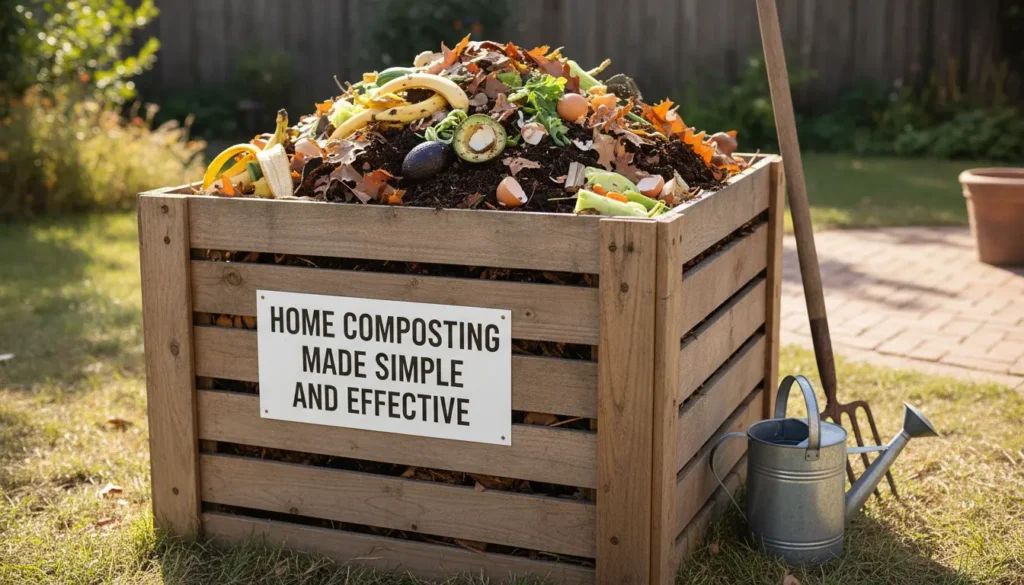
Why start composting at home
Composting at home turns kitchen and garden waste into rich soil that improves plant health and reduces landfill waste. It saves money on fertilizer and supports a circular household system.
This guide gives practical, step-by-step advice for beginners so you can set up and maintain a home compost system with confidence.
Choose the right system for home composting

Selecting a compost method depends on space, time, and how much waste you produce. Small apartments and large gardens need different solutions.
Common home options include:
- Closed compost bin (tumbler) — good for small yards and faster decomposition.
- Open bin or compost heap — flexible for larger gardens and bulky yard waste.
- Worm bin (vermicompost) — ideal for apartments and kitchen scraps only.
- Bokashi system — for those who want to compost cooked food and meat with fermentation first.
What to add to your compost
Successful composting balances carbon-rich “browns” and nitrogen-rich “greens.” The ratio affects speed and odor.
Greens (nitrogen)
- Vegetable peelings, fruit scraps, coffee grounds
- Fresh grass clippings
- Plant trimmings
Browns (carbon)
- Dry leaves, straw, shredded paper, cardboard
- Small wood chips or sawdust in moderation

A typical home target is roughly 2–3 parts browns to 1 part greens by volume. Adjust as needed to control moisture and smell.
Step-by-step setup for home composting
- Pick a location: a well-drained spot with partial shade helps control moisture and temperature.
- Prepare the base: add twigs or coarse material at the bottom to improve airflow.
- Layer materials: alternate thin layers of greens and browns instead of adding large single piles.
- Moisture: aim for a damp sponge feel. Add water if it is bone dry, or more browns if it is too wet.
- Turn regularly: for faster compost, turn the pile every 1–2 weeks to add oxygen and distribute heat.
Maintenance and troubleshooting for home composting
Regular checks prevent common problems. Use these quick fixes when you notice issues.
Bad smell
- Cause: Too much green material or poor aeration.
- Fix: Add dry browns, turn the pile, or increase ventilation.
Slow decomposition
- Cause: Not enough nitrogen, moisture, or surface area.
- Fix: Add more greens, chop materials smaller, or moisten the pile.
Pests
- Cause: Exposed food scraps or meat in open piles.
- Fix: Use a closed bin, bury scraps in the pile, or switch to bokashi for cooked food.
Harvesting and using finished compost
Compost is ready when it is dark, crumbly, and smells earthy. Small systems can take 2–6 months depending on conditions.

Use finished compost to:
- Top-dress lawns and flower beds
- Mix into potting soil or garden beds at 10–30% by volume
- Make a compost tea for liquid feeding
Did You Know?
Composting reduces household greenhouse gas emissions by keeping organic waste out of landfills where it would produce methane. Even small bins divert significant waste over a year.
Small real-world case study: Apartment worm composting
Case study: Maria, a city apartment dweller, started vermicomposting in a 2-bin worm box on her balcony. She collected coffee grounds and vegetable peels and added shredded cardboard as bedding.
Within three months she produced rich worm castings used to feed her balcony herb pots. Her weekly food waste dropped by nearly 50%, and she no longer bought commercial potting mixes for herbs.
Practical tips and quick checklist for home composting
- Chop or shred large pieces to speed decomposition.
- Keep a small kitchen caddy with a lid to collect scraps and reduce trips.
- Record additions and turning dates to see what works best.
- Use gloves and a hand fork for turning to reduce mess and strain.
- Avoid adding diseased plants, pet waste, or large meat and dairy portions unless using bokashi.
Final thoughts on composting at home
Home composting is low-cost and adaptable. Start small, monitor conditions, and adjust the mix of greens and browns.
With a little attention, you will produce valuable soil amendment and reduce your household waste stream while supporting healthier plants.



