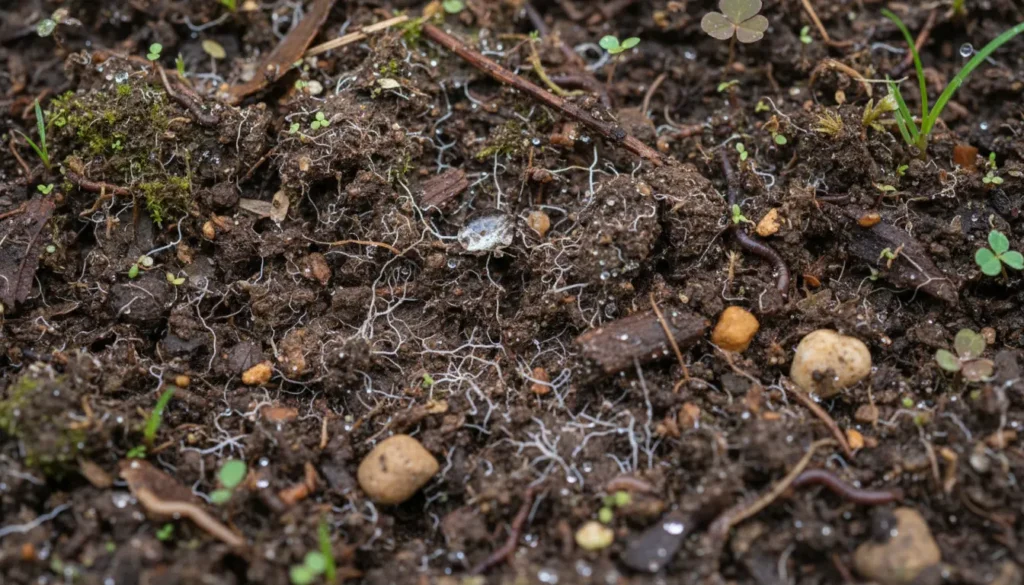
Healthy soil is more than a growing medium. Researchers explain why soil health affects climate resilience by linking soil function to water cycling, carbon storage, and plant health.
How soil health affects climate resilience
Soil health determines how the land responds to droughts, floods, heat and storms. When soil structure and biology are strong, landscapes retain water, support diverse plants, and buffer extreme events.

Researchers use experiments and field monitoring to show that soils with higher organic matter and active biology are better at absorbing heavy rainfall and releasing moisture during dry periods. That improves both short-term farm outcomes and long-term landscape stability.
Soil health and climate resilience: the links
There are direct, measurable links between soil condition and climate outcomes. Improved soil health reduces runoff, lowers erosion, and increases carbon storage.
These changes protect crops and infrastructure and lower greenhouse gas emissions by keeping carbon in the ground rather than in the atmosphere.
Key soil properties that build climate resilience
- Soil organic matter: Increases water-holding capacity and feeds soil microbes that improve structure.
- Soil structure and aggregation: Well-aggregated soils absorb water faster and reduce surface runoff.
- Soil porosity and infiltration: More pores mean better drainage in wet periods and better storage for dry spells.
- Biological activity: Earthworms, fungi and bacteria cycle nutrients and bind soil particles together.
- Plant root systems: Deep roots pull carbon into soil and create channels for water movement.
How researchers study soil health and climate resilience

Scientists combine field trials, remote sensing and laboratory tests to measure soil responses under variable weather. Common metrics include soil organic carbon, infiltration rate, bulk density, and microbial activity.
Long-term experiments help separate short-term weather variability from real changes in soil-driven resilience. This evidence-based approach is why recommendations for farmers and land managers often come from multi-year studies.
Practical practices to improve soil health for climate resilience
Researchers recommend several management steps that are practical and scalable. These practices raise soil organic matter, protect soil structure, and support beneficial biology.
- Cover cropping: Keeps living roots in the soil year-round, reduces erosion, and adds organic matter when residues decompose.
- Reduced or no-till: Minimizes disturbance, preserves soil structure and fungal networks, and reduces erosion risk.
- Crop rotations and diversity: Break pest cycles, improve nutrient cycling, and support varied root architectures.
- Organic amendments: Compost or manure slowly build organic matter and improve water retention.
- Agroforestry and perennial integration: Deep-rooted trees and perennials add stable carbon and improve landscape water balance.
- Managed grazing: When done correctly, it can stimulate plant growth, distribute organic matter, and maintain ground cover.
Simple actions anyone can start
- Mulch high-traffic areas to reduce compaction and evaporation.
- Test soil organic matter periodically to track progress.
- Plant short-term cover crops between main crops to hold soil.

Every 1% increase in soil organic matter can improve soil water-holding capacity by roughly 1 to 1.5 metric tons of water per hectare, depending on soil type. That can matter during dry spells.
Measuring progress: simple indicators farmers can track
Not all monitoring needs a lab. Farmers can use practical indicators to judge whether soil health practices are working.
- Soil organic matter tests: A periodic lab test shows long-term trends in carbon storage.
- Infiltration test: Measure how quickly a set volume of water soaks into the soil.
- Soil texture and compaction: Feel and simple penetrometer checks reveal root limitations.
- Biological signs: Look for earthworms, root depth and active residue decomposition.
Case study: A farm that improved climate resilience
A mixed crop-and-livestock farm in the Midwest US shifted to reduced tillage, cover crops and rotational grazing over a five-year period. The farm focused on building soil cover and adding compost where needed.
After several seasons the farmer observed less surface runoff, more uniform crop emergence, and better forage availability during a dry spell. Neighbors reported greater yield variability in the same dry year.
This practical example mirrors research findings: small management changes that increase soil organic matter and cover can translate directly into more stable yields under extreme weather.
Takeaway: Steps to align soil management with climate goals
Researchers explain why soil health affects climate resilience: healthier soils buffer weather extremes, store carbon, and sustain productivity. The good news is that many improving practices are actionable and cost-effective.
Start with simple monitoring, choose one or two soil-building practices, and scale up as you see positive signs. Over time, better soil equals better resilience for farms and landscapes alike.



